
If you ask most families what a Step Down Unit is, you’ll usually hear one of two answers.
“It’s where patients go before they go home.”
Or:
“It’s basically ICU, just with fewer machines.”
After years of caring for patients during this critical stage of recovery, I can tell you that both answers miss the point.
A Step Down Unit (sometimes called an Intermediate Care Unit or High Care Unit) is not simply a stop between intensive care and a normal hospital ward. It is one of the most important phases of recovery. Patients here are no longer in immediate danger of dying, but they are far from fully recovered. In many ways, this is where the hardest work actually begins. If you require a step down facility, Greentree Sub Acute Hospital will be able to assist in all your needs
If there is one lesson I have learned throughout my career, it is this:
The ICU saves your life, but the Step Down Unit gives your life back.
Understanding what happens during this stage helps families replace fear with realistic expectations and appreciate the incredible work taking place behind the scenes every single day.
What Is a Step Down Unit?
A Step Down Unit is designed for patients who are too stable for intensive care but still require close monitoring and advanced medical support. Greentree Sub Acute Hospital offers post operative surgery rehab for all patients
These patients may have recently experienced:
- Major surgery
- Severe infections
- Stroke
- Heart attacks
- Respiratory failure
- Traumatic injuries
- Multi-organ failure
- Complex medical illnesses
Although they no longer require one-to-one ICU care, their condition can still change rapidly. The goal of the Step Down Unit is to identify subtle changes long before they become emergencies while actively rebuilding the patient’s strength and independence.
Read our latest blog: Is a Step Down Unit Right for My Recovery?
What Actually Happens During the First 48 Hours?
To understand this better, let me introduce you to a patient named Robert.
Robert was 62 years old and recovering from severe pneumonia complicated by Acute Respiratory Distress Syndrome (ARDS) and sepsis. He spent ten days in ICU, including six days on a ventilator.
By the time he arrived in the Step Down Unit, he had survived the crisis.
Now the real recovery had to begin.
Hour 0 to 2: Arrival in the Step Down Unit
Robert arrived exhausted.
He was no longer on a ventilator but still required high-flow oxygen delivered through a warmed, humidified nasal cannula.
Physically he was dramatically weaker than his family expected.
- His muscles had wasted after prolonged bed rest.
- His hands trembled.
- A deep wet cough interrupted every conversation.
- He still had a central IV line, arterial line and urinary catheter.
Emotionally, he was overwhelmed.
One question kept coming up.
“Am I safe here?”
His wife shared the same uncertainty. The room looked different from ICU. The staff were different. The constant one-to-one attention was gone.
What families often don’t realise is that the transition itself is carefully planned.
The ICU nurse performs a detailed bedside handover with the Step Down Unit nurse before leaving. Together they review:
- Laboratory trends
- Ventilator history
- Medication plans
- Recent complications
- Current treatment goals
Immediately afterwards, the Step Down Unit nurse establishes a completely new baseline assessment.
Comprehensive Assessments Begin
The initial assessment typically includes:
- Neurological examination
- Respiratory assessment
- Heart rhythm monitoring
- Skin assessment for pressure injuries
- Pain evaluation
- Mobility assessment
These findings become the benchmark against which every future change is measured.
Day One: Recovery Becomes Active
One of the biggest surprises for families is how many specialists suddenly become involved.
The Step Down Unit shifts the focus from keeping patients alive to helping them recover.
The Multidisciplinary Team Gets to Work
Throughout Robert’s first day he was assessed by multiple healthcare professionals.
- The physician reviewed blood results and adjusted antibiotics.
- The respiratory therapist began carefully reducing oxygen support.
- The physiotherapist evaluated his ability to sit, stand and eventually walk.
- The occupational therapist assessed daily living activities.
- The speech therapist evaluated his swallowing after prolonged ventilation.
Simply sitting on the edge of the bed required two therapists.
After only a few minutes, Robert was drenched in sweat and struggling to breathe.
To his family, it looked alarming.
To the rehabilitation team, it was exactly what they expected.
Eating Becomes Hard Work
Many families are shocked when patients struggle to eat.
After days of mechanical ventilation, swallowing muscles weaken considerably.
Robert was initially cleared only for:
- Pureed foods
- Thickened liquids
Even finishing a few spoonfuls left him exhausted.
Day Two: Small Victories Matter
Recovery in a Step Down Unit is rarely dramatic.
Instead, it is built on dozens of small victories.
By the second day Robert had already achieved several important milestones.
- His oxygen requirements were reduced.
- High-flow oxygen was replaced with standard nasal prongs.
- His arterial line was removed.
- His central IV line was removed.
- His urinary catheter was removed.
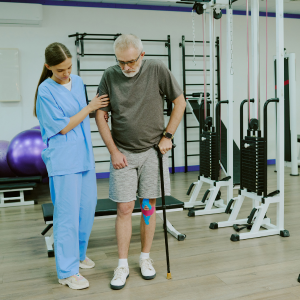
- He stood using a walker.
- He walked several tentative steps to a chair.
Perhaps the biggest improvement wasn’t physical.
His fear began to disappear.
Instead of asking if he was safe, Robert and his wife started tracking daily goals on the room’s whiteboard.
Their mindset shifted from surviving to recovering.

The Biggest Misconceptions Families Have
Throughout my career, I have noticed that most family anxiety comes from misunderstanding what recovery should look like.
“Why Isn’t There a Nurse Sitting With Them All the Time?”
This is probably the most common concern.
Families often mistake reduced visibility for reduced care.
In reality, patients are still being closely monitored, often through continuous telemetry, scheduled assessments and frequent observations.
The difference is that patients are gradually being encouraged to regain independence.
“Why Do They Look Worse Than Yesterday?”
This surprises almost everyone.
Patients often look more exhausted after leaving ICU.
The reason is simple.
In ICU, machines perform much of the body’s work.
In the Step Down Unit, patients begin doing that work themselves.
Breathing.
Standing.
Eating.
Coughing.
Walking.
Every one of these activities consumes enormous amounts of energy.
“Why Are They Making My Loved One Walk So Soon?”
Early mobilisation is one of the most effective treatments available.
Walking helps:
- Prevent blood clots
- Improve lung function
- Reduce muscle wasting
- Restore balance
- Speed recovery
It may look uncomfortable, but delaying movement often creates far bigger problems.
A Patient Who Changed My Perspective Forever
One patient I will never forget was Marcus.
Marcus was only 45 years old.
After surviving severe abdominal trauma and haemorrhagic shock, he was transferred successfully into the Step Down Unit.
Everyone thought the danger had passed.
His family was laughing.
They were packing his belongings.
Marcus mentioned feeling slightly short of breath.
Nothing dramatic.
Just tired.
His nurse noticed something else.
His heart rate had quietly increased from 80 to 105.
His oxygen saturation had slipped from 98% to 93%.
Those numbers alone weren’t alarming.
The trend was.
Recognising these subtle warning signs, the nurse immediately escalated care.
A CT scan confirmed a pulmonary embolism.
Treatment began immediately.
Marcus never needed to return to ICU.
He recovered completely.
What Marcus Taught Me
Marcus reinforced three lessons I have never forgotten.
- The Step Down Unit is a defensive shield, not a waiting room.
- Never confuse stable with safe.
- Listen to trends, not isolated numbers.
Sometimes the earliest signs of deterioration are almost invisible.
Recognising those tiny changes is exactly why Step Down Units exist.
The Biggest Lesson I Have Learned
If someone remembers only one thing from this article, I hope it is this:
The ICU saves your life, but the Step Down Unit gives your life back.
Hospitals rarely explain that patients often appear worse before they begin feeling better.
This creates tremendous anxiety for families.
In ICU, patients are heavily supported.
In the Step Down Unit, those supports are gradually removed.
The patient must now breathe independently.
Clear their own lungs.
Stand on muscles that have almost disappeared.
Learn to eat again.
Learn to walk again.
The exhaustion families witness is not usually a sign of failure.
It is the price of recovery.
The Step Down Unit is where patients stop being passive recipients of life support and become active participants in their own healing.
A Story That Reminds Me Why This Work Matters
I often think about Elena.
She survived catastrophic pancreatitis that resulted in multi-organ failure.
After almost four weeks in ICU, she entered the Step Down Unit having lost nearly fifteen kilograms of muscle.
She couldn’t even lift her hand to brush her own hair.
For several days, progress felt painfully slow.
Then came the moment none of us will ever forget.
The Longest Ten Yards
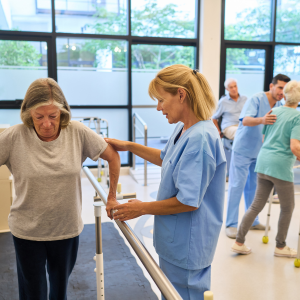
On her fourth day, her physiotherapist and nurse helped her stand using a walker.
Every tube had to be organised.
Every movement required planning.
Her legs shook uncontrollably.
She looked terrified.
Then she took one tiny step.
Then another.
Her husband stood at the end of the corridor watching quietly.
Step by step, Elena shuffled towards him.
When she reached the whiteboard marking the halfway point of the unit, she stopped.
She looked at her husband.
She laughed.
Then she cried.
Those ten yards represented far more than walking.
They proved to her that she was coming back.
Final Thoughts
The Step Down Unit teaches something that no monitor can measure.
Recovery is not simply about laboratory values, oxygen levels or heart rhythms.
It is about rebuilding confidence, reclaiming independence and rediscovering hope.
If your loved one seems exhausted, discouraged or overwhelmed during this stage, remember that healing is rarely linear.
The trembling.
The frustration.
The overwhelming fatigue.
These are often not signs that recovery has stopped.
They are signs that recovery has truly begun.
In my experience, some of the greatest victories in medicine are not dramatic rescues in an ICU.
They are the quiet moments when a patient stands for the first time, walks a few steps down a corridor or smiles because they finally believe they are going home.
Those moments remind me why the Step Down Unit is one of the most remarkable places in any hospital. It is where patients stop merely surviving and begin the courageous, often messy, journey of getting their lives back.